Showing posts with label food. Show all posts

Monday, February 1, 2016

Foodie Pick: Organic Buttermilk

Organic Buttermilk


I came across Kalona Supernatural brand and was very impressed. It is organic, I didn't  know  that  organic butter milk existed. This brand has a lot of other dairy products and eggs. The brand has been around since 2010 the company has great family values and works closely with small farmers. Their value is in integrity and this is witnessed on their website.  It can be found at Whole Foods and the other locations can be located on thier website at www.kalonasupernatural.com

Wednesday, October 30, 2013

Foodie Pick/ Health Pick: Spaghetti Squash


Spaghetti Squash  

It is time for Spaghetti Squash. I have seen all over the Internet where did the Spaghetti Squash go? I have to asked the same question, but to the produce guy. It is considered a winter squash, yet they begin to appear in October. I tried this a while ago and loved it. Spaghetti Squash has a tender texture with a slight crunch.  I have not yet gotten one this year; but am planning to. I plan to make it like a regular red sauce Italian spaghetti but substitute the squash for for the pasta.    

The health benefits of eating Spaghetti Squash is that it has beta carotene, folic acid, potassium and vitamin A. It is nice on the waist line with approximately 42 calories per one cup serving and 4 grams of dietary fiber. This is a great way to reduce some carbohydrates. It is an easy way to incorporate more vegetables into your meal plan. This recipe is great for everyone and those with a special diet of Dairy Free, Gluten Free, Low Sodium, and Vegan.         

Easy Spaghetti Squash Recipe

1 Spaghetti Squash 
1 onion
1 Teaspoon pepper
1 Tablespoon of Italian seasoning  
1 Tablespoon of fresh garlic 
1 jar red spaghetti sauce (This is where the easy is)


Method:

Preheat oven to 375 degrees and halve the squash length wise. Spoon out the seeds (some people save the seeds and love to roast and eat the seeds like pumpkin seeds; I have not yet tried this.) 

Put in casserole dish with cut sides down. Put 1/2 cup water and bake for 30 to 35 minutes until tender. 

Use a fork to rake across the squash creating a spaghetti like texture. 

Warm the sauce and put in the garlic, onion, pepper and Italian seasoning.

Then combine with the Spaghetti Squash.   

Happy Cooking! 


Thursday, March 14, 2013

Foodie Pick: Forks Over Knives Movie Review

http://www.forksoverknives.com


My husband and I recently watched Forks over Knives on Netflix. My husband also borrowed the movie from a friend, where I watched the bonus features. The movie details how food can be used as a medicine. The benefits can reverse conditions like Heart Disease, Type 2 Diabetes and different Cancers.  


The movie follows a biochemist and a surgeon that were raised on a farm from an early age. This  shares their discoveries and individual studies. There is also a look into the life of patients struggling with chronic conditions. The patients go on the plant based diet and it changes their lives dramatically. This shares the benefits of plant based diets and how it can be used for prevention. 

In the bonus features of the DVD, it shares how there are a lot of tax dollars that are used for dairy. Starting with the Drink Milk ads (with those celebrities, very pricey). To how fast food is being persuaded to add cheese and promote cheese items more. There is a big difference in the cheese that you buy without hormones and at cheese shops. The cheese used in fast food along with the cheese you can buy in a box is very processed. It has been found that some of this processed cheese is one molecule away from plastic.  


I appreciate that the film makers brought awareness to the research that was found about meat products. I would have liked to seen more touched on about hormones, processed foods and how food is limited. Especially if you are going to do the plant based diet to stay away from genetically modified everything and to stick to organic; to receive full health benefits.  Again, I myself am a Clean Eater, which means I eat organic without hormones and pesticides.  I especially love cheese; so much that I have invented an invisible mouse that eats the cheese in my house. This movie did make me ask the question of, "Why are meat products pushed and promoted so much?" I do plan to reduce the amount of meat products that my family consumes and buy even more plant based foods.        


Tuesday, February 12, 2013

Foodie Pick: Hummus Recipe


Hummus


This is a Hummus recipe that I have tested and is husband approved. I made this when I did a Mediterranean food week. The base of this recipe is from a Mediterranean cook book that I own. There are a lot of health properties in Hummus. It is rich in protein and chickpeas are known for preventing buildup of cholesterol in the blood vessels. It can also help correct blood sugar levels. This recipe has Omega 3 fatty acids, iron, vitamin B6, manganese, copper, folic acid and amino acids. It is also good if you have a special diet of: vegan, gluten-free and vegetarian.


1 cup dried garbanzo beans (soak overnight covered with water)
Juice of two large lemons
2 large garlic cloves, unpeeled
4 tbsp. extra-virgin olive oil
1/4 teaspoon ground cumin
2/3 cup tahini, at room temperature
Salt and Pepper
Paprika, for garnish
1/4 cup chopped flat- leaf parsley, for garnish
Warm Pita bread, to serve
Method

In a medium saucepan, cover the chickpeas with 2 inches of fresh water. Add the garlic cloves and bring to a boil. Simmer over moderately low heat until the chickpeas are tender, for 40 minutes. 

Drain and rinse the chickpeas under cold water.
In a food processor, puree the chickpeas add olive oil and garlic cloves. Add the cumin along with tahini and lemon juice and process until creamy. Season the hummus with salt and pepper transfer to a serving bowl. Garnish with parsley and paprika.

Sunday, January 27, 2013

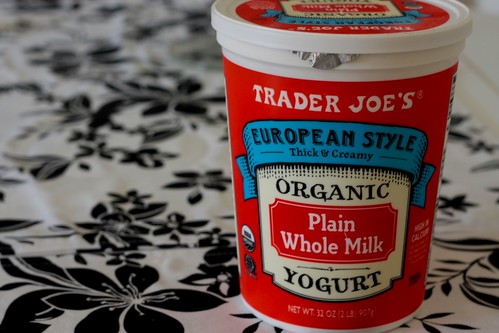
Foodie Pick: Cut Calories By Using Yogurt!


www.traderjoes.com


I recently started eating a lot of yogurt. I only buy organic yogurt because it has all the probiotic properties. The calorie comparison is a lot with yogurt having 9 calories a tablespoon, versus 99 for regular mayonnaise and 30 for sour cream. 

A while ago I accidently put yogurt on my chili dogs instead of sour cream and didn't notice a difference. It was still very good. I have replaced yogurt for mayonnaise, since I am not much of a mayonnaise fan. 

A good replacement for sour cream is a tangy Greek yogurt. The Greek yogurt has a creamy texture. This is a great low calorie replacement. When cooking with yogurt, you have to be careful with the temperature and cook at a low heat. The yogurt can be added to the end, when the dish is finished cooking. 

Another good use for yogurt is for baking. If you would like to cut the fat in half; use half of the butter or oil and put the other half with yogurt that the recipe calls for. Milk and water in a recipe can be replaced with 1/4 of the liquid with yogurt, this adds more flavor and texture. Buttermilk can also be substituted with yogurt. It is also great to use as a base for a favorite dip. 

For a low calorie desert, plain yogurt can be sweetened up with honey, vanilla and or with fresh fruit. This saves a lot of unnecessary sugar that is already in sweetened yogurt. 

Save calories today by trying yogurt!

Saturday, January 12, 2013

Foodie Pick: Shiitake Mushroom


Shiitake Mushrooms

This is a self made recipe that was inspired by a dish that I had at a restaurant. I had one of those moments of sitting there and said, " Oh this would be so good if it had this and that." I made the recipe the following week and it was so good. I miss having this recipe while pregnant. The Shiitake Mushrooms can cause a little stomach discomfort for some (Looking at husband). I myself did not experience this.  

Shiitake Mushrooms are great. They have great health benefits of reducing cholesterol, strengthens immune system, prevents cancer, prevents thrombosis (blood clots) and aids in weight loss. There is a lot of nutrients vitamins B2,  B3, B5, B6, Manganese, Phosphorus, Fiber, Potassium, Selenium, Zinc, Copper, Vitamin D and Magnesium.       


Shiitake Parmesan
1 bunch of scallions chopped medium
1 C white wine
1/2 C Butter
16 oz of linguini
6 cloves of garlic
1/2 lemon juiced
3 tbsp. fresh parsley
1 tbsp. red pepper flakes
2 tsp. black pepper
salt to taste
1/2 pound shiitake mushrooms
1C parmesan & 1/2 C parmesan for serving


Method 

Bring a large pot of lightly salted water to a boil. Add linguine, and cook for 9 to 13 minutes and drain.

Heat butter in a large saucepan over low heat, and saute garlic about 1 minute. Mix in wine, lemon juice, salt, and pepper.
Mix shiitake mushrooms, butter, parsley, red pepper flakes and parmesan into the saucepan. Cook 2 to 3 minutes. Stir in the cooked linguine, and continue cooking 2 minutes, until well coated. Dish and put remaining parmesan on top.

Thursday, December 6, 2012

Foodie Pick: French Dip Roast Beef


This recipe is from Food.com and my added two cents of what I am planning to do to change the recipe. This recipe is calculated for four people. This recipe stood out to me because it is a slow cooker recipe. My slow cooker and I have became better friends lately. There is something about food that is slow roasted and all the flavors coming together perfectly. I want to make this recipe because I have not had an awesome french dip sandwich. I have went to different restaurants and even famous restaurants, known for their "Famous French Dip Roast Beef" and I was not impressed. Now I am going to make this and hopefully impress my husband first and impress myself.     


1 1/4-1 1/3 lbs boneless chuck roast
1/4 cup soy sauce
1/3 beef bouillon cube
1/3 bay leaf
1 -1 1/3 peppercorns
1/3 teaspoon dried rosemary, crushed
1/3 teaspoon dried thyme
1/3 teaspoon garlic powder
4 French rolls, split

*I would add fresh garlic and onion to add more flavor and use beef stock instead of a bouillon cube.*

Directions:
1. Place roast in a 5-quart slow cooker.
2. Combine soy sauce and next 6 ingredients.
3. Pour over roast.
4. Add water to slow cooker until roast is almost covered.
5. Cook, covered, on LOW for 7 hours or until very tender.
6. Remove roast, reserving broth.
7. You may shred roast with a fork and serve on sandwich rolls with the broth on the side for dipping.

Friday, November 23, 2012

Foodie Pick: Bill Granger's Banana Maple Upside-Down Cake Recipe


        Ingredients
    3.5oz unsalted butter, softened
    7.8oz superfine sugar
    4 eggs
    1tsp vanilla extract
    5.5oz plain all-purpose flour
    1tsp baking powder

    Caramel Topping
    1.8oz unsalted butter
    2.1oz firmly packed brown sugar
    2.1fl oz maple syrup
    4 bananas, sliced in half lengthways to serve
    Preheat the oven to 350 degrees Place the caramel topping ingredients in a small saucepan. Cook, stirring, over medium heat for 10 minutes, or until the sugar has dissolved and the syrup is rich and golden..

    Pour the syrup into 9 inch greased or non-stick springform cake tin and arrange the sliced bananas, cut-side down, over the base of the tin.

    Place the butter and sugar in a bowl and beat until pale and creamy. Add the eggs one at a time, beating after each addition, then add the vanilla extract.

    Sift the flour, baking powder and a pinch of salt, then gently fold through the butter mixture. Spoon the batter evenly over the bananas and smooth the top with a spatula.
    Place the cake on a baking tray to catch any escaping syrup and bake for 35 minutes, or until a skewer inserted into the center of the cake comes out clean. Remove from the oven and leave in the tin for 5 minutes to cool slightly.
    Transfer to a large serving plate. Serve warm, with vanilla ice cream if desired.


Saturday, June 30, 2012

Foodie Pick: PICKING CHERRIES LITERALLY


Image found at agricultureguide.org 


1 Cherry Tree = 30 Cherry Pies


I recently went with some family to go cherry picking, it was my first time. It's a small cherry farm around Landcaster, CA.  The way it worked was you grab a bucket and if you filled up your bucket it was about $40. It was fun for about 5 minutes for me. I got bored and started taking some silly and artistic pictures. There is a catch 22 when it comes to picking fruit. All you want to do is eat the fruit right after you pick it off the tree, but that is against the rules. As you drop the cherry into the bucket, you feel separation anxiety because you really really want to eat it. Then you want to fill your bucket all the way to the top where it over flows then you stop! It cost $40 a bucket, then you realized I will be happy with my half a bucket. I started to think about the  first person that looked at a cherry and said, "Hum I am going to eat this." I think this is a good simple minded person activity, good for small children. I think it would have been better with learning some history and more about cherries. There was not enough mental stimulation or learning. The plan after picking the cherries was to meet up and make pies. It was an all day thing with a last pie in the oven at 10 o'clock at night.  

Cherries are a great Super Fruit. The darker cherries are higher in antioxidants and vitamin levels. All cherries help to reduce the risk of heart disease and cancer. Cherries also have Melatonin in them that help regulate the heart rhythm and sleep cycle. Cherries are a great source of  Vitamin A,  Potassium, Magnesium, Iron, Folate and Fiber. Cherries are good for the brain for the prevention of memory loss. It is a natural anti-inflammatory which it is great for those with arthritis and it has been used for many years for gout. There has been studies done that proved that cherries combat body fat and lower sugar levels. 

In the United States there are more than a 1,000 different varieties of Cherry trees Most of the trees blossom  over a three week period, in late May and early June. America crops produce 300 million pounds of cherries. About 75% of the American crop comes from Michigan. Go Cherries!

Monday, February 20, 2012

Pick of the Week: Have you tried a Sumo Tangerine?


Image found at specialty produce.com


This is the Sumo Tangerine. This is a fruit of beauty. It is sweet and juicy. The skin is the right amount of thickness, very easy to peel and seedless. 

In 1970 a Japanese farmer mixed a sweet satsuma and a large orange. It took 30 years of trials and errors and the crop was not released until 1991. Now the fruit is available in the United States, Japan and Korea. It is now also grown in California.

My first encounter with this fruit is when I was standing in line at the grocery store with my Husband. The people in front of us had the most weirdest looking (what we thought was an orange) fruit. Then the couple started to peel the fruit right there at the check stand. When they bit into the fruit they closed their eyes and started to make moaning "yum" noises. I have only seen this type of excitement with 2,000 calorie sweet desserts. They then went back to get more and kept repeating, "Everyone should try these." So, we went and bought one to try. And YES, we went back and bought more. Once we went Sumo we have never turned back. 

The season for the Sumo Tangerines is listed February through May. I have only found this fruit at Whole Foods for about $2.99 a pound and it only seems to stay stocked for about a month to six weeks. It is a good source of fiber, folate and potassium. It is low in acid which makes it great for people with sensitive stomachs. This is a Must Try!      

Thursday, December 22, 2011

Foodie Pick: The Dangers of Eating Microwaved Food


Image found at science photo library.com 

The story of the Microwave begins with two researchers Blanc and Hertel that found, cooking in a Microwave significantly changes the nutrient value in food. They did a two month study with eight individuals that ate food that was Microwaved and took blood test immediately after the food was consumed. The test reveled that hemoglobin levels decreased. These two scientist were told that if they released their findings that they would face hefty fines and up to a year in prison. Years later the gag order was removed and this is how this story is shared today.

After World War 2 Russia experimented with Microwave ovens. Their research started 1957 and is still ongoing. They had a lot of great findings in their research. When pre-pared meats are Microwaved d- Nirosodiethanolamine is created; this breaks down the protein and pulls in radiation.(cancer causing) When milk and cereal is heated up in the Microwave, the amino acids are mixed and splits the proteins.(cancer causing) Free radicals are created when heating up vegetables.(cancer causing) The indigestion of Microwaved foods caused higher percentage of cancerous cells in the blood. Malfunctions occur in the lymphatic system causing the degeneration of the immune system. The unstable catabolism in the Microwaved food, lead to disorders of the digestive system. Those who ingested Microwaved food lead to disorders of the digestive system and showed more: stomach cancers, degeneration of peripheral cellular tissues and excretory system function. As a result Russia banned Microwaves in 1976. The ban was lifted in 1987 after Perestroika.

There are violent changes in the food by Microwaving it and causes the food molecules to form new life forms called radiolytic (mutation) compounds. This causes deterioration in the blood and immune system. Standing in front of the Microwave is dangerous for your health because Microwaves leak radiation. You can see how it makes cells explode when putting an egg in the Microwave. There has also been a link found in Microwave emissions and fertility problems in men.

The Microwave is a form of electromagnetic energy, something like light waves and radio waves. Microwaves are very short waves of electromagnetic energy that travels at the speed of light.

The body is electrochemical and any changes to this from a Microwave will effect the whole physiology of the body. Degeneration and circuit breakdowns of electrical nerve impulses also take place. Long lasting residual effects of magnetic traces are left though out the nervous system and lymphatic system. It destabilizes and interrupts the production as well as hormonal balance in men and woman. The Microwave causes high levels of brain wave pattern disturbance through out a persons brain. From this disturbance, there were many problems found: loss of memory, loss of the ability to concentrate, emotional instability , reduced intelligence and effects sleep. It causes the brain to “short out” the electrical impulses in the brain, which can cause long term brain damage. The body doesn't recognize the food that is microwaved and can't metabolize it. Microwaved foods cause stomach and intestinal cancerous tumor growths. When eating Microwaved food, it increases cancerous cells in human blood.

There is a story of an Oklahoma woman that died from a simple blood transfusion because the nurse put the blood in the Microwave to heat it up. The blood was altered by being heated up in the Microwave and killed her.

When the Microwave came into peoples home the way things were done changed forever. People developed short attention spans. The saying of “ all good things come to those who wait” went out the window. People developed a “ I want it now” complex and we have the Nazis to thank. They first invented the Microwave oven, to use to support mobile operations. Now over 90% of American homes have a Microwave oven. I am not one of these homes! Once I started eating Organic, I thought to myself why go through the trouble of getting food with nutrients to put it in a box that just zaps all the nutrients out, it is an oxymoron.         

Thursday, December 15, 2011

Foodie Pick: Corn Syrup & High Fructose Corn Syrup (HFCS)


Image found at Tvtropes.org 

First I will begin with what is Corn Syrup and High Fructose Corn Syrup (HFCS). Corn Syrup is manipulated from the starch of corn. High Fructose Corn Syrup under goes a process that has to create a chemical reaction. The molecules have to change and convert into different molecules. The enzymes also have to change. With this many different reactions taking place before someone consumes it, this makes you wonder what reactions are taking place in your body after you digest it. This causes concern for what it can do to your enzymes, hormonal balance and the health for your over all cells. You can see how High Fructose Corn Syrup looks like a science experiment when the guys from King Corn make Corn Syrup themselves. (This weeks Pick of the Week)

In 1882 Corn Syrup was refined and the production of dextrose (glucose) from corn starch was started. In 1967 High Fructose Corn Syrup was created. By the mid 1980's HFCS was the sweetener used in many soft drinks. From 1977 to 2001 America's consumption of sweetened drinks went up 135%. Corn Syrup now is being re-branded as “Corn Sugar.”

High Fructose Corn Syrup is used in a wide variety of foods, in place of sugar. It is estimated that 78 pounds of Corn Syrup is consumed a year per person. This number wows me! It is said that Corn Syrup is being used in place of sugar for economical reasons; but other countries are not using High Fructose Corn Syrup. What is interesting is that most drinks made outside of the USA don't have Corn Syrup as an ingredient. What else I find confusing is that Coke makes a soda without corn syrup, that has a yellow cap; but only around the time of Passover. Why not give consumers the opportunity all year long?

Beverages that have High Fructose Corn Syrup have high levels of carbonyl that has been linked to cell and tissue damage that contributes to Diabetes. High Fructose Corn Syrup is rapidly absorbed in the blood stream and there is not much of a question of how it has been linked to obesity. It leaches micro nutrients from the body and also increases your appetite. In other studies there have been high levels of mercury found in Corn Syrup. With high levels of Mercury, it can harm the: brain, heart, kidneys, lungs and over all immune system.

With trying to stay away from Corn Syrup, start by reading all labels because Corn Syrup will be where you least expect it. This can be found in foods that are not sweet like: any processed foods, snacks, breads and meats. Most of the bottled and canned beverages contain Corn Syrup. These include: soft drinks, sports drinks, lemonades and ice teas. You will find that a lot of fast foods contain Corn Syrup. There are a lot of people out there that are Diabetic. Big or small you don't have to join them. When the body can no longer filter the 78 pounds of syrup, your blood becomes syrup.      

Friday, November 18, 2011

Foodie Pick: Does Milk Really Do A Body Good?


Image found at altadena milk.com


We have all seen those commercials that tell us to “drink our milk” and all those ads with the milk mustaches.  Then learning about rBGH makes you wonder what have we been drinking.  What I noticed when I was recycling that the milk bottles that were not rinsed out completely turned a neon green color over time.  This is what made me research what is going on with the milk. I have never seen this happen with my Organic milk containers.  I will always buy Organic Grass Fed milk. You can taste the difference between the treated milk and the un-treated milk.  The two companies that are well distributed that do not use the hormone are Clover and Altadena. There are more companies just look at the label for Organic and says Not From Cows Treated With rBGH. To make sure what you are drinking I would research the company that you are buying your dairy foods.

In 1985 the US started the research and gave the official Go in 1994 to use the hormone. rBST & rBGH is a generically engineered bovine growth hormone. They are similar, if not the same. This is sold everywhere under different trade names that are licensed under the Monsanto Corporation that invented this product. The rBST is injected into cows to increase their milk production. It increases the milk production by 15%.  It has been rumored that rBST has been linked to cancer of the breast, colon, lung and prostate and others.   

The cows treated with this hormone have painful side effects. It creates inflammation of the utters that create a pus and then gets into our milk. I have heard that sometimes blood gets into the milk because the utters are so raw and inflamed. To treat these cows and to try to heal their utters, they are pumped with antibiotics. As a result the antibiotics get into the milk and then we drink it. These are very heavy duty antibiotics to treat a 1,000 pound animal. With us receiving all these antibiotics through our dairy products and meat, we build our resistance up to antibiotics. So when we go to the hospital with a simple virus (cold), a stronger antibiotic has to be used that can be damaging to the liver, kidneys etc. Please take in consideration the dairy products you consume: butter, cheese, sour cream and the rest of your dairy products.            

Thursday, November 10, 2011

Foodie Pick: Why Is Organic Better?

Image found at thedailygreen.com

When you walk into a store that has only Organic produce the smells are overwhelmingly amazing. You can close your eyes and smell the apples, oranges, broccoli, bananas and ohh the strawberries. When you pick up the apple you do not see a reflection of yourself on the waxy surface; but from the smell of the apple you can almost taste the fresh crisp apple in your mouth. Organic foods are produced without synthetic pesticides or chemical fertilizers. They do not contain GMO’s (Genetically Modified Organisms). The plants or animals DNA have not been altered and the food was not grown in a lab. 

I pick Organic food because it taste better and it still has its nutrients. It has not been washed in Clorox. The crops don’t have synthetic pesticides, artificial fertilizers or use radiation to kill bacteria. Animals on Organic farms eat only Organic feed.

The animals are not confined and can roam around free. The animals are Not injected with antibiotics or synthetic growth hormones.

I do not want my fruits and vegetables to be soaked in a Clorox bath were they loose all their nutrients and flavor and then sprayed with a waxy substance so the can be pretty. Gallery lights are set above the produce so it can shine off the wax and almost sparkle. I want to see natural texture and bruises that tell you when the fruit and vegetables are ripe. I would have never thought so many pesticides were used. There are about 40 pesticides used on non Organic brown rice. About 51 pesticides used on non Organic leafy green vegetables. Those non Organic strawberries have a whopping 59 pesticides used on them. Why I am trying to stay away from so many chemicals, because the exposure to chemicals can cause DNA damage and breakage. This leads to genetic mutations, cancer, and sometimes death. Organic is good for life.

*EXTRA PICKY TIP – Your investment in your health today; will save you thousands of dollars in healthcare cost in your future. *